
NOTE: This series on the system of chakras is meant to provide an analysis through the spiritual lens of Islam, which is rooted in the purifying principle of One. It is not an endorsement of polytheistic systems, which the Yogic system denies anyways, nor is it an endorsement, guide, or instruction for any spiritual practices or prescriptions. Where the term ‘god’ or ‘deity’ is used, it is used loosely only to retain common language while understanding these words are metaphors. Where practices are mentioned, it is only informational. While the theme of these posts is to explore the deeper metaphysical architecture of these systems and spiritual technologies thereby enabling us to see the principle of One that pervades all revealed religions as a proof of God, it does not imply the doctrinal teachings of the school of Perennialism (different from “perennialism”).
Continuing from the previous post on the phenomenology of color, what we understand as color is not a positive quality, rather, it is a negative quality, as in, it is the result of negating light. When light is fully reflected, it appears white. However, when a color appears to us, it is only because all other colors have been absorbed. The color that appears to us is the only wavelength range on the electromagnetic spectrum that is being reflected back at us. Particular color is thus the absence of all wavelengths but one defined range of the electromagnetic spectrum.
The reason why something appears red is not because it is actually red per se, but because it holds back all of the other colors that make up the white light except red. If color pertains to qualities, then what we reflect through the self in terms of qualities are a part of the fuller spectrum of qualities contained in the essence at the heart of the fitra [primordial human nature]. We are, as beings in the physical world, what we radiate of the metaphysical world, and so the idea behind spiritual growth and becoming a fully fledged being is learning to radiate all of the qualities of the transcendent light of what some traditions call the Pure Mind. To become a fully fledged being therefore is to radiate all colors, to encapsulate and express without hindrance or suppression the Beautiful Names of God. This is where the significance of the spiritual sciences pertaining to the activation of the subtle energy centers comes into play.
A common symbol for the soul, for the True Self, in the world’s spiritual-religious traditions is the pure white radiant light. In the Tibetan Book of the Dead for instance, recognizing this light as our true nature is the key to salvation in the bardo [ བར་དོ ] realm, also understood as barzakh [ برزخ ] in the Islamic tradition – the interstice realm that we enter upon physical death. That light is the Pure Mind, or, transcendent consciousness, which is free from kleshas [ क्लेश ], the 108 defilements or mind poisons that confound us in this life. The Pure Mind is free from attachment and from clinging, where attachment and clinging to phenomenal form underpins the metaphysics of idolatry. Therefore, the Pure Mind is free from suffering, from delusion and illusion and all spiritual pollutions that defile the heart; the Heart that is veiled in spiritual pollution cannot recognize the radiant White Light of its true nature in the interstice realm, and thus for such souls, there is the manifestation of its suffering. When one has realized their true nature in this life, as if they are the dreamer who has realized that they are dreaming, or that they are the universe looking into the world of embodied lights and forms, then it is said that one has become an awakened soul or a freed soul, what in Islam is characterized as the ibn al-waqt [son/daughter of the moment]. One is present fully in the moment of reality because one has become conscious of God. And since God is the source of reality and life, our own existence as an expression of life becomes intense. It is precisely this state that the Awakened Ones, who in our tradition we call Prophets and Messengers resided in while alive in this world, who when they spoke, they did not do so on behalf of a self in an egoic sense but on behalf of God, where the manifestation of the self that is in this state is called the True Self.
This pure white radiant light, as both a metaphor and as a direct and ethereal experience, is True Being as it is the light of The First Being, referenced in various scriptures as the single soul from which all other souls were created and which emanate from. When knowledge of it is lost, it is said to cause to arise the causal body, the seed from which the energy body, or in the Islamic tradition the subtle body, and then the subsequent physical body, emerges from.
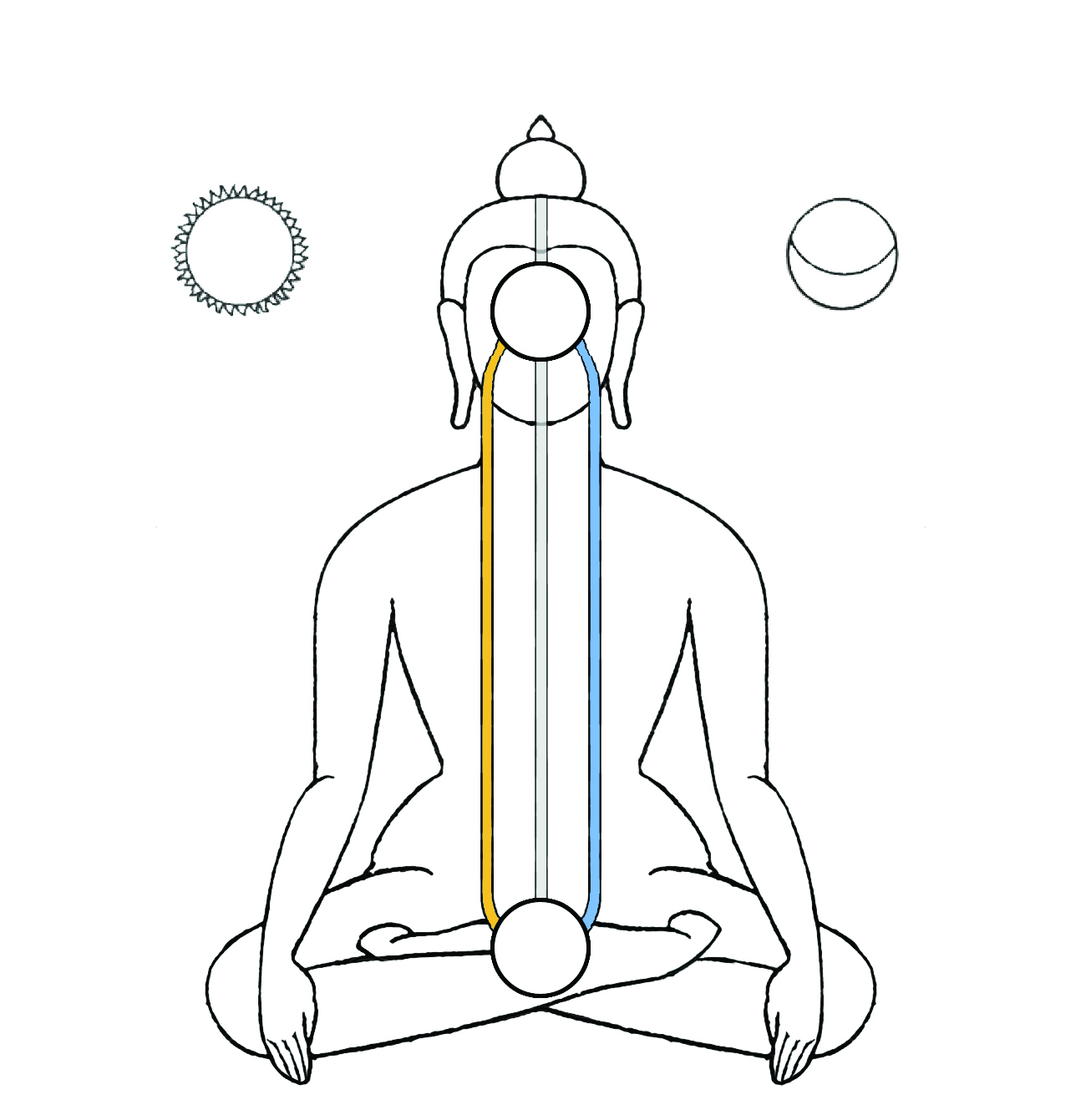
In the Yogic tradition, the energy body can be said to be made up of channels of prana [ प्राण ], or, vital life energy called nāḍī [ नाडी ]. Is it said that there are hundreds of thousands and even millions of nādis. The Shiva Samhita treatise on Yoga states that out of the 350,000 nādis, 14 are particularly important, and among them, three are the most vital. The three principle nādis run from the base of the spine to the head, they include the Ida on the left, the Sushumna in the center, and the Pingala on the right.
The Ida and Pingala represent the basic duality of material existence or created reality. It is this duality which we traditionally personify as Shiva and Shakti. Shiva and Shakti are not deities or gods, as is commonly misunderstood by many. Rather, they are masculine [represented by the sun] and feminine [represented by the moon] polar principles who, through their mutual interaction, bring about and underpin created reality. As masculine and feminine principles, they also represent or underpin the logical and the intuitive aspects of the human being, which means that the human being is made up of both the masculine and the feminine polar principles of creation. It is based on this that life is created. Without these two dualities, life would not exist as it does right now. Before the beginning, there is only God alone, who alone is truly primordial, there is no duality. But once the creative act occurs by which creation is brought about, there is duality.
Sushumna, the central space, unlike Ida and Pingala, remains dormant. However, Sushumna is the most significant aspect of human spiritual physiology because it is the path into the spiritual dimension of our existence, and thus, into our true nature. Only when energies enter into Sushumna, life really begins. Fundamentally, Sushumna is attribute-less, it has no quality of its own.
The 114 Chakra Energy System and the Expression of the Pure Mind
Along the energy pathways, there are 114 junctures or energy centers, special points of intensity, called chakras [ चक्र ]. According to Yogic teachers, the word “chakra” means “wheel” or “circle” because they embody movement from one dimension to another. While they are represented as triangular in shape, the circular aspect of the depiction is meant to represent the ripple-like emanation of energy. Emanation signifies movement from a higher dimension to a lower dimension, and so the ripple-like effect represents the vibrations of energy from the subtle dimensions to the manifested dimension. It is this manifested energy that makes up the human being, from consciousness and the contents of consciousness to the physical body, including psycho-emotional states and qualities. All of these are represented in the various colors of the spectrum.
Chakras are associated with color, meaning that they give off aspects of the pure white radiant light of the Pure Mind. To use a metaphor, the energy body is like a crystal prism that receives and then refracts the transcendent white light into various colors, creating a spectrum. The points from which the various colors emerge are represented by the different chakra centers, which ultimately find expression in the physical world through the physical body, especially in psycho-spiritual states, emotional experience, and fundamental inclinations that are folded into one’s personality.
Out of these 114 chakras, two are outside of the physical body. Of the remaining 112, only 108 can actually be worked upon, the remaining four will become cultivated as a consequence of purifying the other 108. According to Yogic teachers, the number 108 has manifested in the human system because it is a significant number in the making of the solar system, hence, 108 is significant in various spiritual practices. As mentioned above, there are 108 kleshas or mind poisons described in Buddhist literature that must be purified for one to awaken, which implies that each chakra point pertains to a particular kleshas or defilement.
It is also no coincidence that in the Islamic tradition, there are 114 chapters that comprise the Qur’an. It is believed that each chapter has its own spiritual color rooted in the metaphysical meaning which that chapter represents. Therefore, each has teir own psycho-spiritual effect within us, each one like a unique medicinal remedy. When recited and chanted in a melodious way, conjuring a symphony of vibrations to express a variety of emotional energies, and when contemplated and meditated upon, there is a resonance within us energetically that we feel in the movement of the Heart, as if it is moving along the waves of the symphony of sound. Since each chapter has its own energetic state, that means there are 114 unique energetic states that may be experienced. It may, therefore, be the case that each of the 114 resonances may have a healing effect particular for each energy center in the body. In other words, if there are 114 chapters, and if each chapter has its own spiritual energy as far as healing goes, then each chapter may be said to align with each of the 114 energy centers, including the two that are outside of the physical body.
The Principle Energy Centers - Eastern and Western-Islamic Spiritual Systems
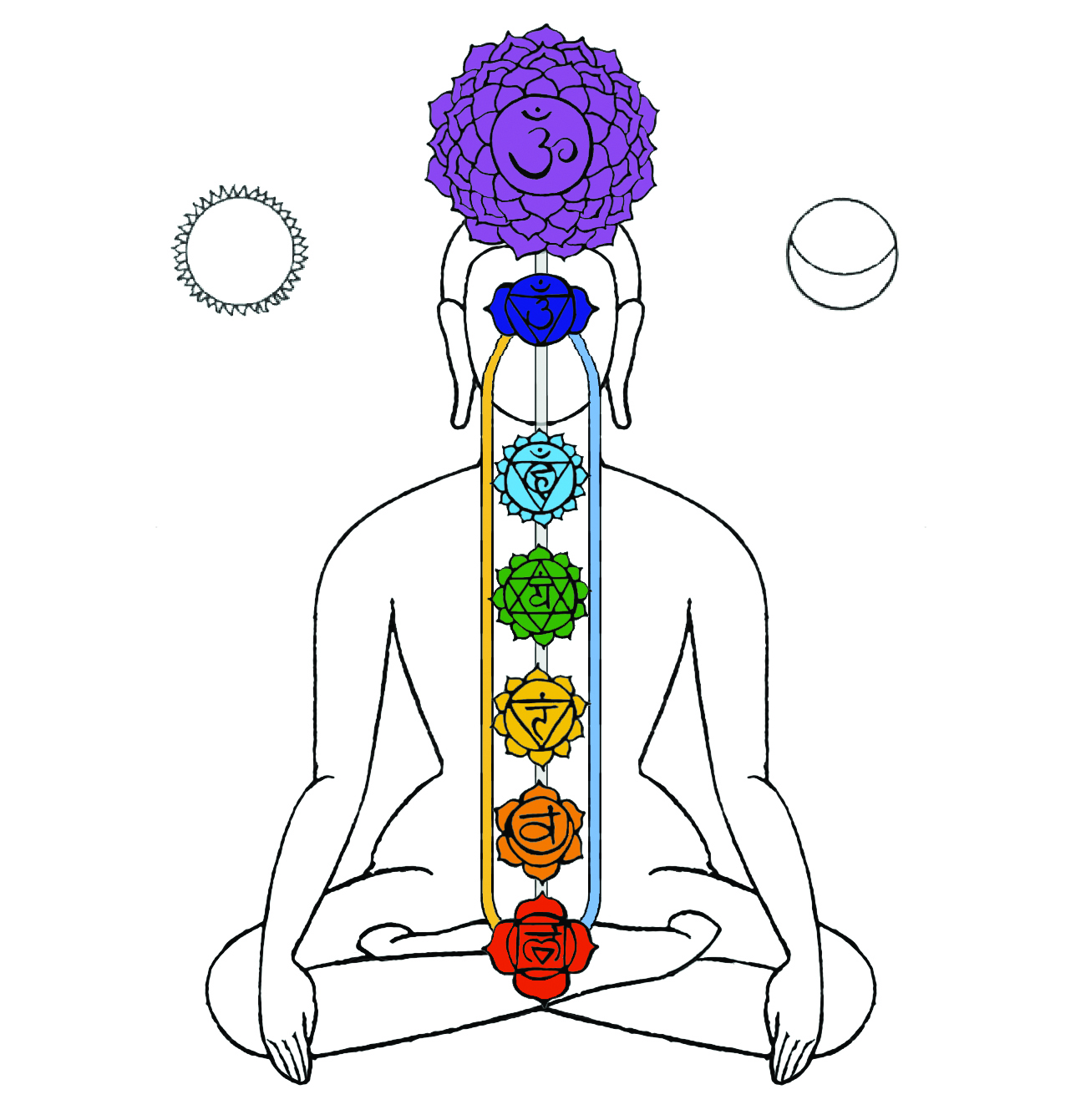
In the Yogic system, out of the 114 chakras, 7 are especially significant as special points of intensity. From the seven firmaments and the seven heavens to the seven souls, the number seven has metaphysical and spiritual significance, which appears to be the case universally. The seven fundamental chakras are known as Muladhara, which is located at the perineum, the space between the anal outlet and the genital organ; Svadhisthana, which is just above the genital organ; Manipuraka, which is just below the navel; Anahata, which is just beneath where the rib cage meets; Vishuddhi, which is at the pit of the throat; Ajna, which is between the eyebrows; and Sahasrara, also known as Brahmarandra, which is at the top of the head, where when a child is born, there is a soft spot.
In the vast array of mystical schools within the Islamic tradition, there are different interpretations on the subtle centers in terms of their number and their location, and whether they are fixed or unfixed. However, they in their own systems, correspond to the seven dimensions of the human soul.
The Naqshbandi order focuses on the spiritual Heart, or Anahata chakra, to use a Yogic parallel. In Islam, the word for Heart is qalb [ قلب ], which also refers to the chest cavity region. It is within this region that the four energy centers that make up the outer Heart reside, and in between them is the fifth energy center representing the inner Heart, or, the True Heart or the Spiritual Heart. On the left side there are the two centers called Qalb and the Sirr, which are located along the Ida channel; on the right side there are the two centers of Ruh and Khafi, which are along the Pingala channel. When these four lataif [ اللطائف ] are activated, then the energy center called Ikhfa, which is located along the Sushumna energy channel in the middle, becomes activated. Ikhfa corresponds to the Yogic chakra, Anahata, otherwise known as the Heart chakra. The Heart chakra is said to be the meeting place between the material world, for which the sun represents through the Ida channel, and the spiritual world, for which the moon represents through the Pingala channel. It is absolutely striking that we see this parallel between the Yogic system and the Islamic spiritual system of the subtle centers in terms of their operational activation. Just as with Ikhfa appears when the left and the right channels are sufficiently cultivated, the same occurs with regards to the appearance of Sushumna only when Ida and Pingala are activated.
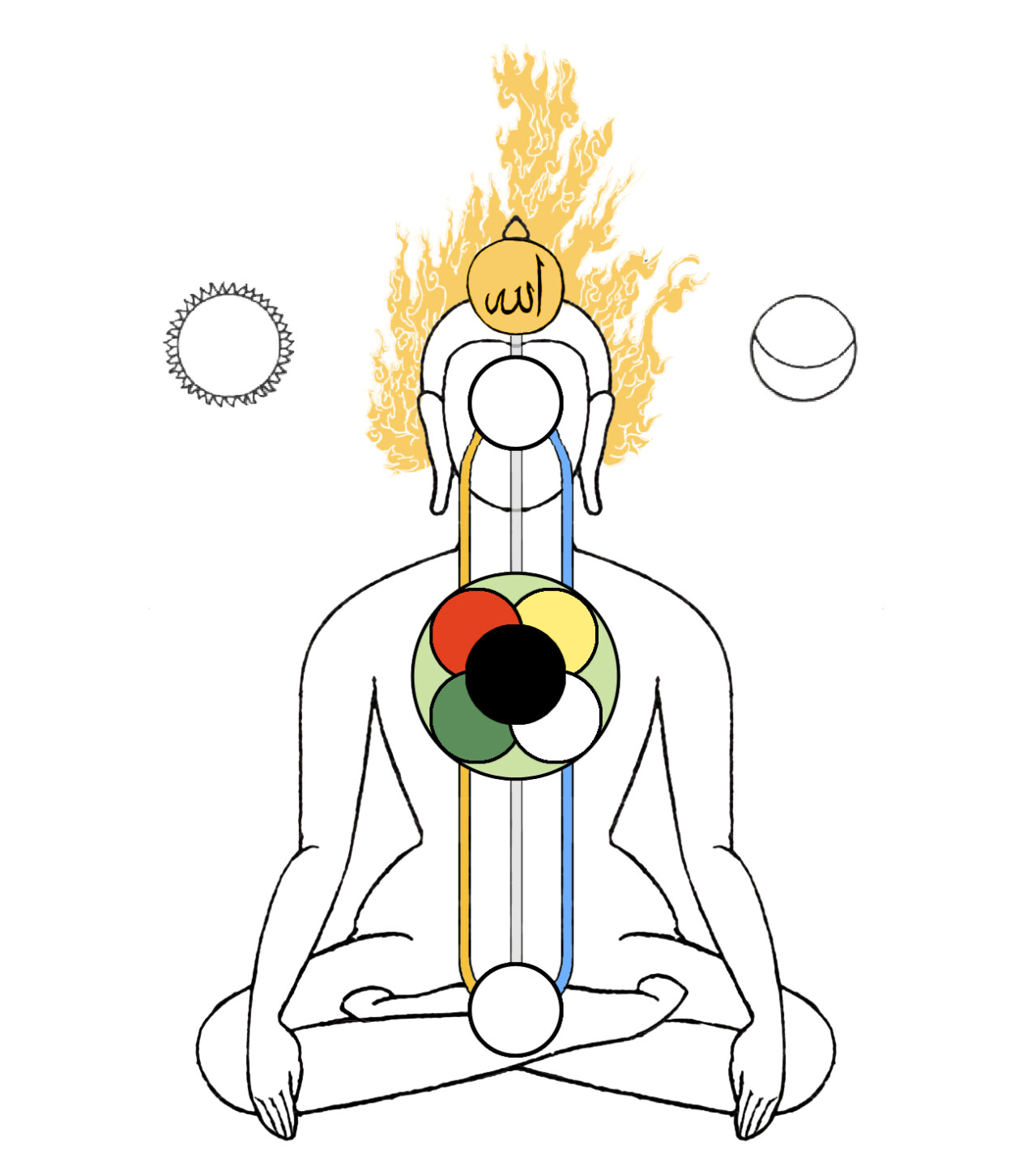
Interestingly, in Islam, it is said that within the depths of the Spiritual Heart there is the horizon between this world and the next, and as the signs are shown to a person regarding the truth of reality, this horizon begins to disappear and at once you find yourself in the world beyond. This represents and corresponds to the ethereal dimension of the Divine Presence, which in the Yogic sciences represents entry into the Sushumna channel. Islam, as a spiritual way, is the way of the Heart, or, the activation of the Heart chakra from a Yogic perspective. The way of the Heart is to activate the energies of the outer Heart so that one may enter into the depths of True Being that resides within the Inner Heart. Interestingly, the Heart chakra in the Yogic tradition as well as in the Islamic tradition is associated with the color green, which is also known to be the color of the Prophet Muhammad ﷺ.
From a Yogic perspective, Shiva, which represents the Supreme Transcendence, revealed 112 basic ways in which consciousness could be explored. Each way corresponds to each of the 112 chakras within the body, each way for traveling the path of Enlightenment corresponds to one particular chakra in the body. According to the Yogis, the way of the Buddha, for instance, was considered a small part of this entire system, focusing on awakening a particular yet primary chakra associated with awareness; the Buddha’s way was the way of awareness. The path of awareness was one aspect of God’s entire system that pertains to the human being.
For these reasons, it may be said that the Islamic path of Enlightenment is through the Heart, and thus, Islam is known as the path of Divine Love. It also highlights why the Prophet ﷺ emphasized the spiritual Heart as the means of Enlightenment and salvation such that his path centered around it: In a sound narration, the Prophet Muhammad ﷺ clearly declared, “Verily, in the body is a piece of flesh which, if sound, the entire body is sound, and if corrupt, the entire body is corrupt. Truly, it is the Heart.” The science of the purification of the Heart, what we know as tazkiyyah, or more popularly as Sufism, is the central principle and essence of the Islamic religion such that without it Islam as a religious-spiritual tradition would does not exist except in name only. It would become like a barren corpse without its animating spirit. While the Buddha was the master of the way of awareness, the Prophet Muhammad ﷺ was the master of the way of the Heart, and so the system of knowledge revealed by the Prophet ﷺ revolves around awakening the Heart chakra.
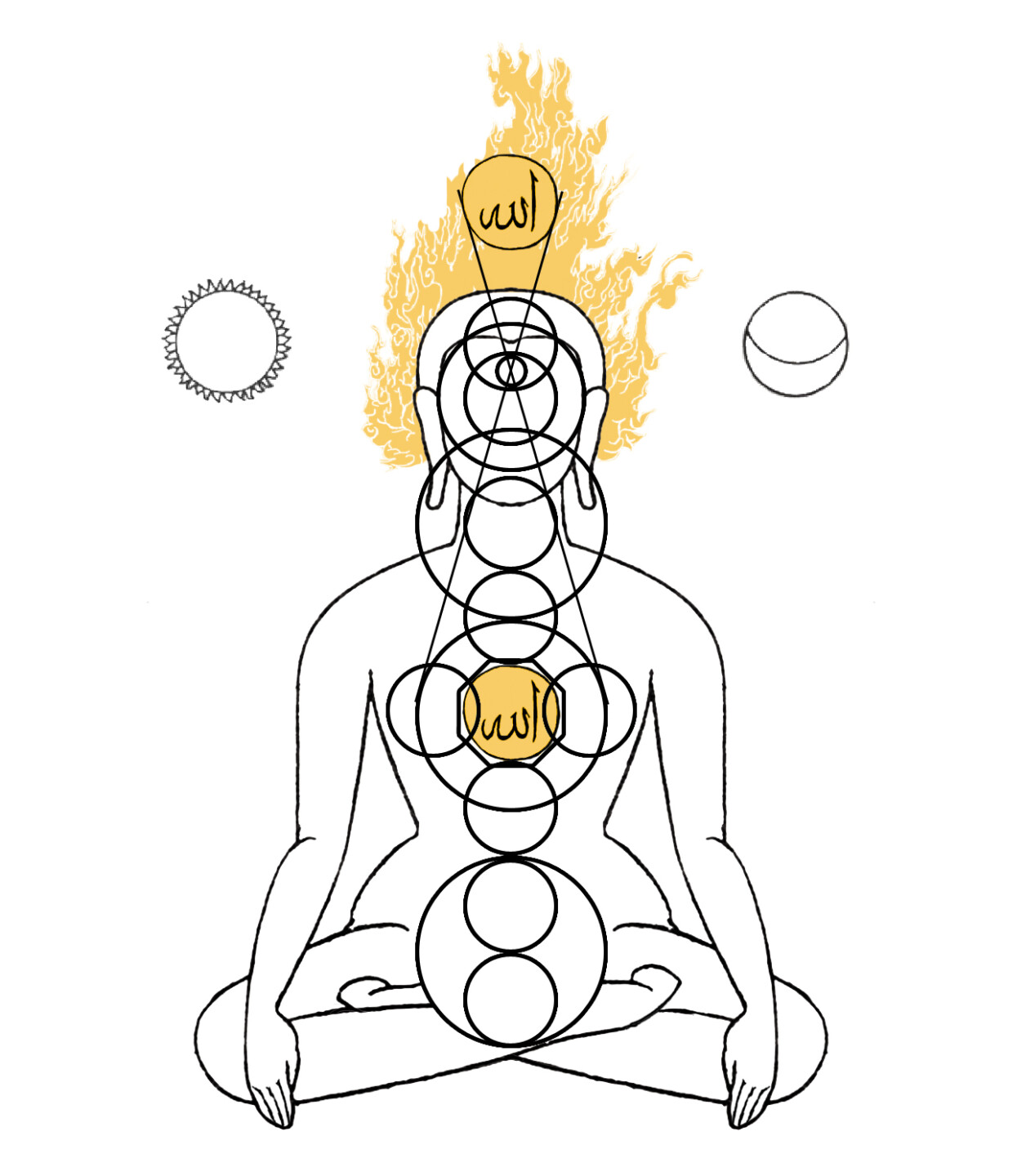
That being said, other mystical schools in Islam, such as the Kubrawi order, focused on the seven principle energy centers, which parallels the Yogic tradition. Muladhara corresponded to Latifa Qalabiyah; Svadhisthana corresponded with Latifa Nafsiya; Manipuraka corresponded to Latifa Qahlbiya; Anahata corresponded to latifa Sirriyah; Vishuddhi corresponded to latifa Ruhiyah; Ajna corresponded to Latifa Khafiyah; and Sahasrara or Brahmarandra corresponded with Latifa Haqqiyah. The seven lataif energy centers are understood cosmologically as “descending” levels through which reality is created and structured. In the process of spiritual development, the individual is understood to “ascend” to and through these levels progressively. Within the microcosm of the human being is therefore said to be the ascending and descending levels of the macrocosm.
References
[1] The 108 Defilements of Buddhism
[2] 7 Chakras: Mystical Dimensions of the Body’s Seven Chakras
[3] John Noyce, The Inner Ascent (2008)
[4] Sadhguru – What is the Significance of 7 Chakras and How to Activate it?
[5] Khafa Lataif Secrets of the Heart – Eternal Message Malakut & Resurrection Sufi Meditation
“The opening of these lataif, these subtle energy points, by you focusing on their realities and their understanding and the knowledges of them, then through the tafaqqur (contemplation) Allah begins to send these lights upon the soul.”