Continuing from the previous post, Enlightenment By Means Of The Return to Oneness, summarizing some of Murata’s writings in Chinese Gleams of Sufi Light, the underlying cosmic nature of worship can be understood more deeply based on Ma Lian-Yuan’s work “Explaining The Descents Of The Macrocosm” and the essential nature of worship as “practicing one” or “making into one”. The soul is the essentializing Principle of the human being, therefore worship as the practice of returning to oneness is the modality of connecting back to our essence. And since disconnection from our essence is the basis of the very concept of trauma, worship is the modality of healing our fundamental trauma and integrating our fractured Being back into a singular Organizing Principle, which arises within us as the God Principle. Its primary characteristics are that of compassion and wisdom since the restitution of trauma entails deriving deeper lessons that expand one’s wholistic perspective of the world based on a deeper understanding of the human condition. This deeper understanding of the human condition, which is universal between all of us, enables for us the ability to relate to others on a fundamental level. This is ultimately the basis of what we call empathy, which through the ability to relate, leads to both compassion and wisdom. Compassion pertains to the manifestation of mercy while wisdom pertains to the manifestation of justice since justice, at bottom, pertains to knowing the proper places of things. It is what allows for discernment, and therefore, right action, right thought, right belief. To connect to our essence is to be in harmony with nature, and so worship as a concept pertains to returning to nature, to our natural primordial state or fitra [فطرة – Nature]. Worship is thus a transformative and essentializing process, not a display of mere piety.
Because the dimensions that comprise the entire structure of the human being reflect the dimensions that comprise the entire structure of the universe, both physically and metaphysically, the human being is said to be a microcosm of the macrocosmic universe. And so, it is through the dimension of the Heart, as kashf [كشف – unveiling] as an immanent experience within consciousness, that we travel through the transcendent dimensions of the macrocosmic universe towards the Divine Presence, which enlivens the Heart. This cannot be otherwise, for when we direct our gaze to the ocean of stars above, is there not a longing, a memory perhaps of a far away home from so long ago? The simultaneous sensation of vastness and insignificance washes over us, opening the Heart which stands between the infinite and the finite, between the eternal and the temporal. It is the inbetween state that hints at the secret path into the world beyond.
Because the dimensions that comprise the entire structure of the human being reflect the dimensions that comprise the entire structure of the universe, both physically and metaphysically, the human being is said to be a microcosm of the macrocosmic universe. And so, it is through the dimension of the Heart, as kashf [كشف – unveiling] as an immanent experience within consciousness, that we travel through the transcendent dimensions of the macrocosmic universe towards the Divine Presence, which enlivens the Heart. This cannot be otherwise, for when we direct our gaze to the ocean of stars above, is there not a longing, a memory perhaps of a far away home from so long ago? The simultaneous sensation of vastness and insignificance washes over us, opening the Heart which stands between the infinite and the finite, between the eternal and the temporal. It is the inbetween state that hints at the secret path into the world beyond.
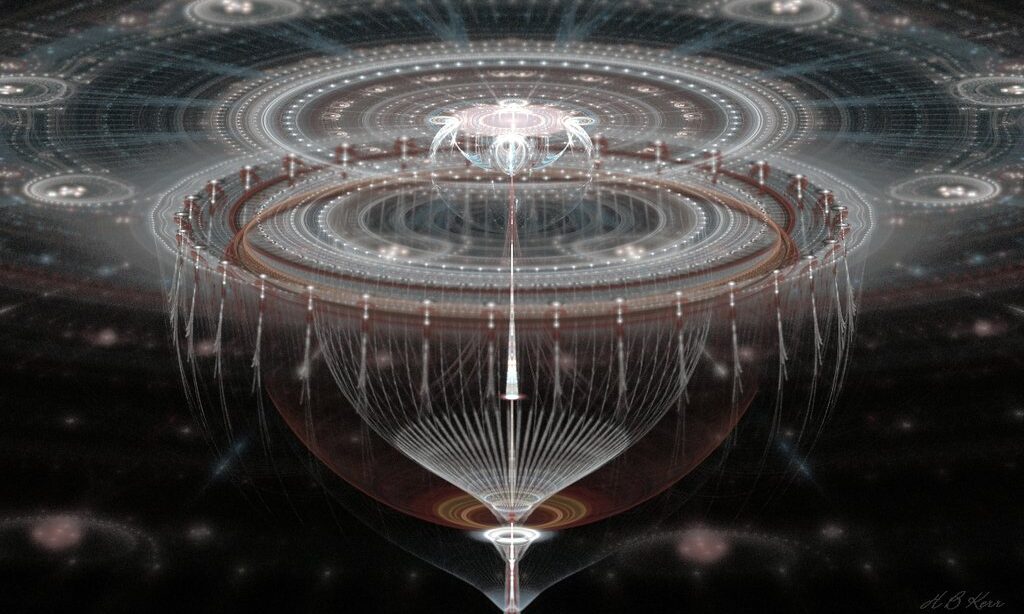
The Realm of Power, called the alam al-jabarut [عالم الجبروت], is the highest realm in Islamic cosmology. It represents Divine Agency as the Acts of ٱللَّٰه [Allāh]. It is from this realm that the Divine Attributes, which transcend all realms, first manifests as the cosmic symphony that we call the created universe, the alam al-malakut [عالم الملكوت], The Realm of Dominion, described in the Qur’an as “The Heavens and the Earth, and all that is between them”, or in the language of the Tao Te Ching, “Heaven, Earth, and the ten thousand things.” This realm includes all of existence, from the transcendental dimensions of the Seven Heavens and the Seven Hells down to the immanent world of Earthly minerals. The Earthly world of physicality is referred to in the Chinese traditions as the “ten thousand things”, and in the Qur’an it is referred to as The Kingdom, the alam al-mulk [الملكعالم] in which humans live. In this terrestrial realm, the more basic aspects precede man: minerals yield to plants, which supports animals, until the crowning purpose of this realm, man, is achieved. But because the terrestrial conditions which gave rise to man are also influenced by, and thus include, the planetary forces of the solar system and the cosmic forces that pervade it, man contains both the spiritual and the physical dimensions of the cosmos itself. Man is a result of not just the Earth, but the solar system itself and beyond. The notion that the human being is a self-existent and independent creature is inherently false, and this highlights the co-arising nature of man within the causal structure of the universe. Man is a microcosmic form of the whole universe, the small world or the al-alam al-saghir [ألم الـصـغـيـر،]. And thus, the human being is the universe personified as the modality of consciousness.
The Realm of Power, called the alam al-jabarut [عالم الجبروت], is the highest realm in Islamic cosmology. It represents Divine Agency as the Acts of ٱللَّٰه [Allāh]. It is from this realm that the Divine Attributes, which transcend all realms, first manifests as the cosmic symphony that we call the created universe, the alam al-malakut [عالم الملكوت], The Realm of Dominion, described in the Qur’an as “The Heavens and the Earth, and all that is between them”, or in the language of the Tao Te Ching, “Heaven, Earth, and the ten thousand things.” This realm includes all of existence, from the transcendental dimensions of the Seven Heavens and the Seven Hells down to the immanent world of Earthly minerals. The Earthly world of physicality is referred to in the Chinese traditions as the “ten thousand things”, and in the Qur’an it is referred to as The Kingdom, the alam al-mulk [الملكعالم] in which humans live. In this terrestrial realm, the more basic aspects precede man: minerals yield to plants, which supports animals, until the crowning purpose of this realm, man, is achieved. But because the terrestrial conditions which gave rise to man are also influenced by, and thus include, the planetary forces of the solar system and the cosmic forces that pervade it, man contains both the spiritual and the physical dimensions of the cosmos itself. Man is a result of not just the Earth, but the solar system itself and beyond. The notion that the human being is a self-existent and independent creature is inherently false, and this highlights the co-arising nature of man within the causal structure of the universe. Man is a microcosmic form of the whole universe, the small world or the al-alam al-saghir [ألم الـصـغـيـر،]. And thus, the human being is the universe personified as the modality of consciousness.
The transcendent realms in relation to the immanent realms represent Knowledge in relation to Power, and Divine Attributes in relation to Divine Acts. Beyond all of these is al-dhat [الذات], the Divine Essence of ٱللَّٰه [Allāh]. It is therefore through the modality of the Divine Acts, the manifested universe, which is epitomized in the movement of man, that we acquire knowledge and wisdom of the Divine Attributes, which are expressed through it. And through knowledge of the Divine Attributes, which is experiential knowledge that adorns the Heart, we connect to the Divine Presence itself. The Divine Acts and the Divine Attributes, that is, the traces of Power and Knowledge, make up the macrocosm, and are thus encapsulated in the microcosm of the Heart. Realization of this is what it means to return to nature, to our primordial state and to be connected to the universe.
That which is “between Heaven and Earth”, within the alam al-malakut [عالم الملكوت], is the Realm of Imagination, the alam al-mithal [ألم المثال], which is the mystical world where physical limitations cease to exist. This realm, according to Suharwardi, exists metaphysically between the ordinary material realm of sense perception and the realm of intellectual abstractions found in Aristotelian philosophy, and is related to the Platonic World from which mathematics descends. The world of pure mathematics, as Roger Penrose explains, has a reality independent of the ordinary type of reality of this world, which we normally think of as real. It is a different kind of reality from the reality of the physical world. There are different levels of reality, and just as the reality of mental experiences interrelates with physical reality, so does the mathematical reality of the Platonic World, which also gives reality to these mathematical notions of physicality.
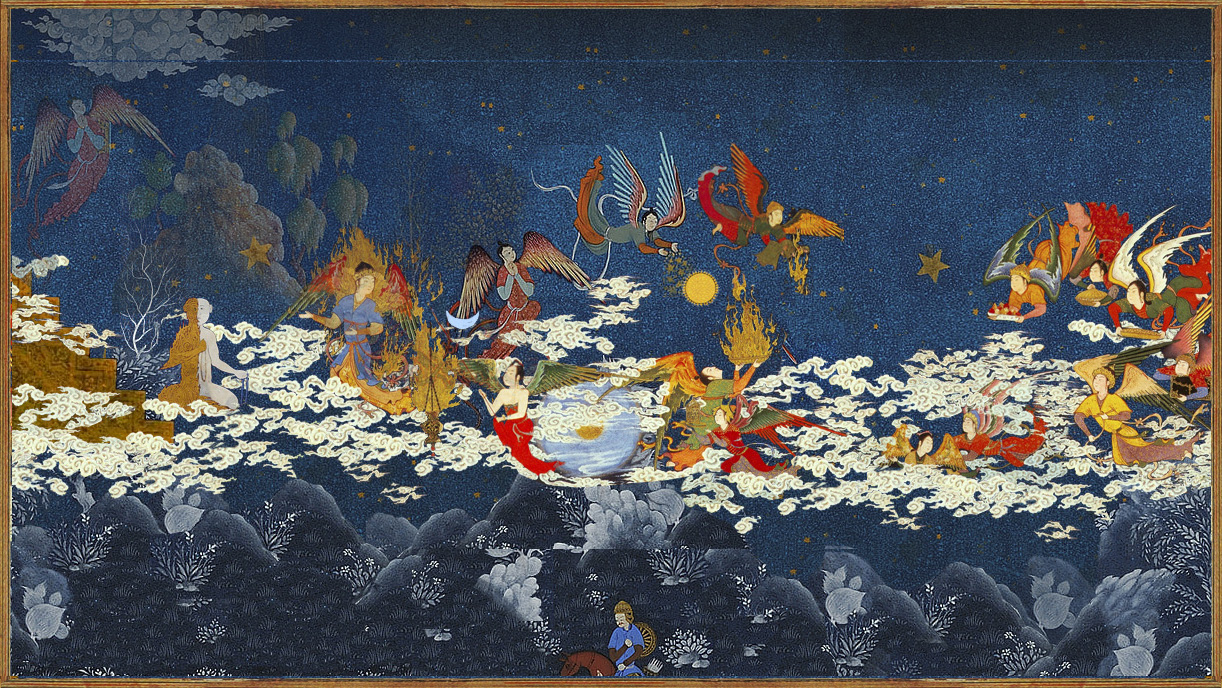
In Islamic Prophetology, Muslim philosophers laid great emphasis on the figurizing function of imagination. Ibn Arabi explains that “imagination is neither existent nor non-existent, neither known nor unknown, neither negated nor affirmed.” It is the broadest of universal planes, since unlike the world of the senses, it contains everything that exists, “real” and “imaginary”. And through the interaction of the Yin and Yang dual aspects of the Supreme Spirit, which are the traces of Knowledge and Power, the Divine Feminine and the Divine Masculine, this realm of pure mathematics, or transcendent Principles, partakes in the quality of existence as material form; the immanent physical world, as an expression of the transcendent Principles, arises and swims within the ocean of consciousness. They are thus accidental features of the all pervasive consciousness, which is universal. This, of course, is Divine Will; a thing is not real except that it partakes in the quality of reality, which alone is God’s; a thing does not exist except that it partakes in the quality of existence, which alone is God’s. All created phenomena are contingent, and as contingent Being, their existence is merely a borrowed quality from God, who alone is the Necessary Being.
The entry point into the alam al-mithal [ألم المثال] is barzakh [برزخ]. In its broadest definition a barzakh [برزخ] is that which separates two things, that which is neither one thing nor another. It is the dream world that partakes of both life and death, the image in the mirror that both is and is not the observer, the unperceivable instant between past and future, the dawn and the dusk when it is neither fully light nor dark, and the moon as it waxes and wanes in its cycle, forever in between the crescent and the void. As Chittick notes, it is that which stands between and separates two other things, yet combines the attributes of both. Within it are all possible things. He goes on to say, “Existence itself is a barzakh (a liminal state) between Being and nothingness.” Between the One, unchanging Being and the equally unchanging nothingness (‘adam) lies the barzakh [برزخ] of the ever-fluctuating existent things.
This interstice world stands as a mesocosm between the spiritual world and the material world. It is the “interworld”, as Henry Corbin calls it, the place where “psycho-spiritual events including miracles, spiritual ascents, and theurgical operations take place.” All spiritual traditions hold that the state between wakefulness and sleep is the entry point of the spirit realm. This dimension of barzakh [برزخ] is the “interval between the present life and that which is to come, from the period of death to the resurrection”. And so, it is commonly understood universally that it is between wakefulness and sleep, between life and death, that revelation descends from, and that contact with the Spirit, the Rūḥ [روح], in all of its infinite manifestations, may occur.
This in between state pertains to the concept of sacred silence, which refers to the esoteric dimension of occultation or khalwat [الخلوة]. While this concept denotes “seclusion” and a condition of being alone, its esoteric dimension emphasizes something far more subtle. That in aloneness, one enters into a state of total freedom from interruption, not just from others but from oneself, from the thoughts of the lower self. The contents of consciousness do not arise, and so consciousness ceases. One stands on the precipice of the barzakh [برزخ], which is none other than the horizon of the Heart. One finds oneself standing at the door of infinity, gazing into that Great Abyss. As Truth is inexplicable, then without effort, communion with the higher spirit may occur.
It is from here that true inspiration descends, and it is from here that true healing occurs. The First Intellect or Universal Intellect [al-‘aql al-awwal] has the same function as al-Farabi’s Active Intellect [al-‘aql al-fa’âl] in communicating with Prophets, and thus as al-Ghazali held, it is restricted in its communication to Prophets, for they alone were able to reach this level of Enlightenment. Indeed, al-Farabi identifies the Active Intellect [al-‘aql al-fa’âl] with the Holy Spirit, the ruh al-Quds [روح القدس] or the Archangel Gabriel of Divine Revelation. The Active Intellect [al-‘aql al-fa’âl] is a cosmic entity which acts as a transcendent intermediary or veil (of light) between ٱللَّٰه [Allāh] and man. Al-Farabi says, “Since the Active Intellect emanates from the Being of the First Cause (al-sabab al-awwal), it can be said that it is the First Cause that brings about revelation to this person through the mediation of the Active Intellect.” However, for non-Prophets, it is the function of the Universal Soul (al-nafs al-kulliyyah), which represents the Feminine Principle, to communicate with them.
To summarize this, the greater degree of Enlightenment that a person attains to, the higher and more universal the dimension of reality that they may commune with. However, the more distant one is from Enlightenment, the lower and more particular the dimension of reality they perceive, which characterizes egoic-Being. The consciousness of the Prophets are informed by the highest levels of the Rūḥ [روح], and with respect to the final Awakened Master ﷺ, by ٱللَّٰه [Allāh]. For this reason it is said that he spoke not on behalf of himself, as in an ego or an imagined self, a persona, but on behalf of The Eternal. His ﷺ Enlightenment experience describes thricely a negation of self and a singular affirmation of The Eternal as the volitional force and the Principle behind his very existence.
The soul, the nafs [نَفْس], which descended from its Source, can also ascend towards its Source again through the process of purification. Al-Ghazali says that “the soul itself is facing toward its Creator”. When the human soul is liberated from materiality, which is to say that when materiality is removed from within the Heart, represented by idols, it is able to return to ٱللَّٰه [Allāh] through the ascending dimensions of the spirit of the cosmos, the Rūḥ [روح]. The Heart therefore represents the doorway into the cosmos, beyond this world and towards the Divine Presence itself. Each station of Enlightenment is characterized by a perspective that is particular to each level of the Supreme Spirit (al-‘aql al-awwal), from all modalities of duality into non-duality. Passage upwards through these ascending realities is only through the gate of death, which pertains to the secret of the Prophetic instruction as the basis of the spiritual path, “die before you die.”
And so this concept of death is intrinsic to the concept of spiritual purification. The gate of death is the basis of the meditative traditions in not just Islam but in all revealed traditions because it is how we pass through the barzakh [برزخ] that separates one dimension of reality from another. In order to pass through, in order to ascend, one must die. And so, even though barzakh [برزخ] is the interstice realm entered upon physical death, because the soul or the nafs [نَفْس] came from there, that is the imagined self, the dreamer may enter this realm again through the portal of the Mind. The human soul, provided it was pure and strong enough, could contact the unseen in waking life as well as in dreams.
Of course, this pertains to the spiritual concept of unveiling, or kashf [كشف]. All that is required is a withdrawal of the soul from the tumult of sensory life, as Ibn Arabi explains. This is a Greek doctrine as well, clearly stated by Plutarch. In all pre-modern traditions, it is precisely through this realm that Realization may occur, and through this Realization on higher planes of experience, transformation and rectification of the Heart may occur on lower planes of existence. That is, healing here in this world occurs through entering barzakh [برزخ] through the Heart since it is the place of potential and possibility. It is in this world of image-exemplars that the dialectical-monologue between the narrator and the various personae of the narrator’s self takes place. What transpires on the higher realms of Being manifest here in the lower realms just as what occurs in our waking experience of life may manifest in our dreams. And so in acquiring a higher and more transcendent perspective, we are able to frame our experiences here in this lower world thereby bringing restitution to unresolved traumas, especially the death of our loved ones. Since it is through the restitution of traumas that they are integrated, and since it is through the integration of traumas that we acquire their underlying wisdom, this path is the means by which we cultivate and mature ourselves spiritually.
References
[1] The Universal Tree and the Four Birds: Muhyiddin Ibn ‘Arabi
[2] Ibn al-‘Arabi’s Barzakh: The Concept of the Limit and the Relationship Between God and the World
[3] Al-Farabi, al-Fusul al-Madani, p. 173: idem, Ihsa’ al-‘Ulum, (ed.) U. Amin, Cairo, 1949, p. 100; idem, Kitab al-Siyasah al-Madaniyyah (al-Farabi’ Political Regime)
[4] Chinese Gleams of Sufi Light: Wang Tai-yu’s Great Learning of the Pure and Real and Liu Chih’s Displaying the Concealment of the Real Realm. With a New Translation of Jami’s Lawa’ih from the Persian by William C. Chittick



Intresting in many ways, your blog is a blessing for humanity, and especially for us muslims. May Allah bless you.