

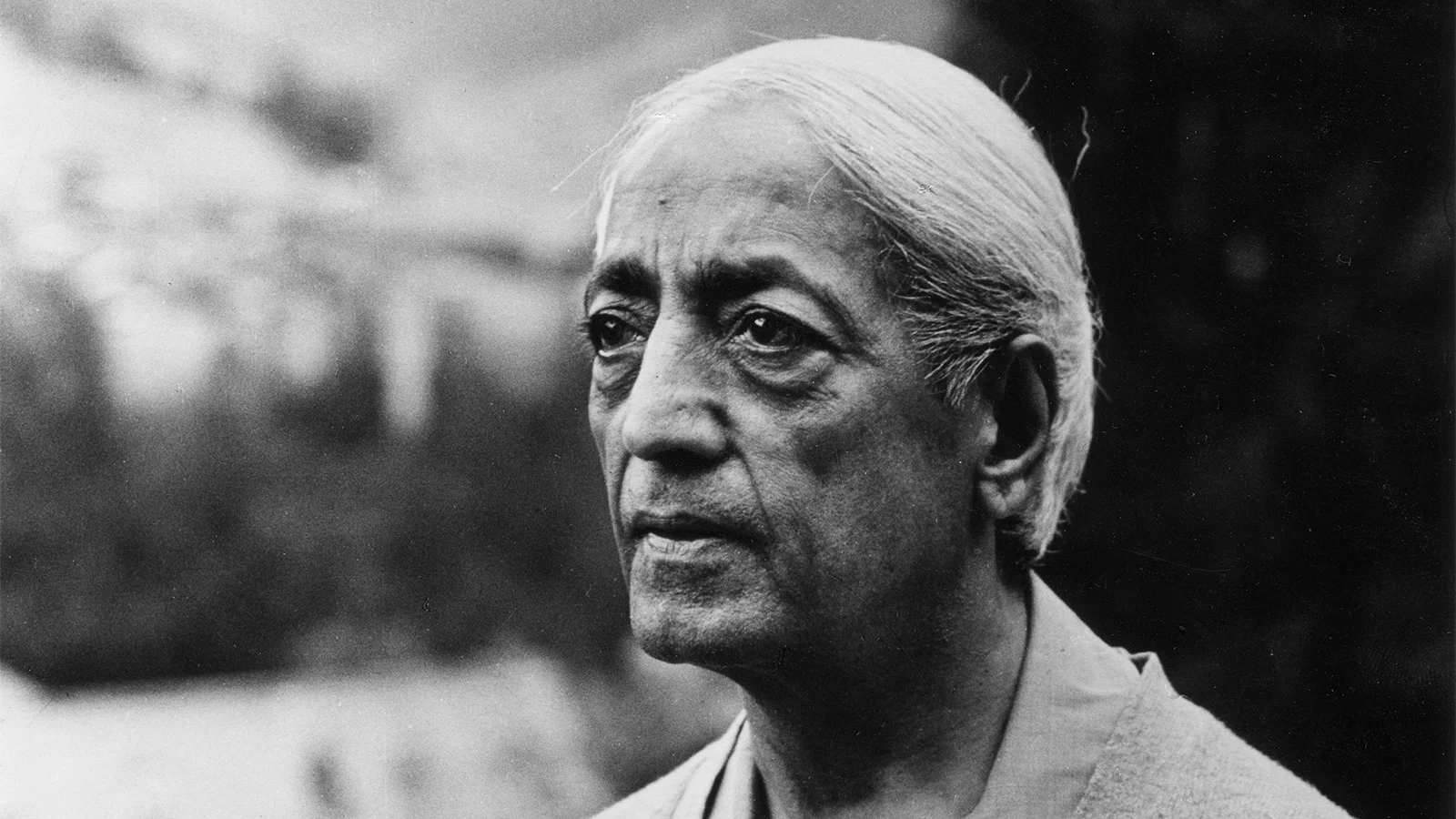
The process of thought is hurt. And how do you prevent future hurt? Not by resistance, not by withdrawal, not by becoming more and more hard. Do you want to wipe out your hurts? Or do you love your hurts? Do you want to keep your hurts? There is deep pleasure in keeping them because it keeps your vitality and energy, to hurt someone else. If you want to be free from all hurt what will you do?
As long as I have an image about myself, that image is going to be hurt. Is it possible to live without a single image? That means no conclusions, which is a form of image, no prejudices, all of these are images. At the moment that you insult me, which is at the moment you say something that is contrary to the image that I have about myself then you hurt me. Now at that moment when you are saying something that is harmful and hurtful, if I am aware of what you are saying, and give my total attention to what you are saying, then there is no registration taking place.
It is only when there is inattention, registration of hurt or flattery takes place. Now when says that you are a fool, can you at that moment, give your total attention. If you do then there is no hurt. The past hurts have gone in that attention. Attention is like a flame that burns out the past and present hurts. – Jiddu Krishnamurti | Extract from Public Dialogue 1, Brockwood Park, UK, 1976
Consciousness and the Contents of Consciousness
There is consciousness and then there are the contents of consciousness. It is when the awareness of the Mind, which precedes and therefore transcends consciousness, falls upon phenomena – the contents of consciousness – on the canvass of the Pure Mind there is birthed consciousness. It is from consciousness that there is then birthed experience as qualia. The contents of consciousness include everything of perceptive experience, from sensations and emotions to thoughts and beliefs as well as the complex associations between all of these that we rationalize into concepts. All that we experience is what we are conscious of, and what we are conscious of exists within the Mind. This is true even for those things that we are unconscious of; it is not that we are unconscious of it per se but that we are too distracted to notice.
Prior to consciousness there is Pure Mind. When Pure Mind becomes confused with the phenomenal arisings, with thought, with the contents of consciousness, then the knowledge of the pure and unadulterated Mind is lost, the Natural Mind as Bodhidharma called it. Pure Mind is confused with the ordinary consciousness of the lower mind, which is intertwined with the contingent phenomena of the contents of consciousness, and thus, we become existentially in flux, heedless, and distracted. As the slumber deepens, we transition from the Pure Mind, the Natural Mind, to the false mind, the little mind, the distracted mind, the mind that is occupied with phenomena. From the vantage of the Islamic paradigm, this is to be in a state of ghafla [heedlessness].
What is within your consciousness is, on the surface level of manifested Being, what you are. But this manifestation is a constant process so rather than Being it is actually Becoming. There is no rest there for us when we are constantly arising and ceasing, constantly in a state of Becoming. The problem however, as far as stress goes, is self-identification with this. The nature of the self, as we relate to it, is a constant process that is in flux. It has no solidity, no permanence to it, no state of rest but only restlessness. That is the nature of the world and so there is no escaping this.
The essence of your self is thought, which puts together this sense of I. Thought is a continual process, and thus, this sense of I is a continual process of arising and cessation, of Becoming. The emptying out of the self is not about terminating consciousness by the termination of the perception of the contents of consciousness. It is about severing attachment to the contents of consciousness , which is essentially to see directly and clearly and experientially the true nature of phenomena as impermanent . And because all phenomena are impermanent, they are in a constant state of arising and cessation. This is to see their temporal nature, which is understood as existence after non-existence. This of course implies that after existence there is thus non-existence. It is so see also their dependent nature, that their arising and cessation is intertwined with causes and conditions that are other than themselves. It lacks true inherent reality, and thus, there is nothing to truly attach to. Attachment to phenomena is fundamentally a consequence of misperceiving the true nature of the world.
Their arising and cessation is not just a description of individual being within the eye of perception, but rather, a holistic description of the interdependent nature of all phenomena that makes up what we call the universe. Through this expanded view of interdependence we see the empty nature of phenomena as lacking inherent reality.
Because this I is composed of the continual process of phenomenal thought, it is to recognize the impermanent nature of the self, the empty nature of self and this sense of I which we identity with. When this occurs, then the self no longer becomes an obstacle for spiritual growth and transformation but a vehicle. It is for this reason that we find many different forms of the self, particularly in Islam, which makes reference to the lowest form of the self as well as to the highest form of the self. As we arrive to the higher stations of the self, which are characterized by contentment with the Real, we are at last in harmony with nature, with true perception.
The Dreamer Awakening
It is because of a deep sense of loneliness and disconnection within us that the self engages in constant distraction. It is an attempt to be occupied with everything except that discomfort within. And then when we mistakenly self-identify with the contents of that internal chatter and distractive process then the false self arises and we enter into a catastrophic delusional state that requires its constant maintenance. This entire process is exhausts us and drains us of our vital life force. But when we attend to the chatter of the mind, not attempting to control it as Krishnamurti says, but merely observing it, staying with it, then you will experience transformation. The awareness of the Pure Mind will move beyond the chatter and to the reason for that chatter, which is the pain within. And when we once again attend to the discomfort, to the agitation, to the pain, and then to the sense of loneliness and absence, then we can once again move beyond it. By being with the loneliness, you will notice that you are not alone, for in attending to it and being with it, it ceases to be the case that are you alone. This is the introduction to the notion of an immaterial presence, of the dreamer who observes, and it opens up for us the fundamental questions of the mysterious nature of Being.
It is when the awareness of the Pure Mind no longer falls upon the contents of consciousness that there is the absolute cessation of consciousness. In the cessation of consciousness does the Mind become truly quiet, not asleep but awakened, entering that profound state of Sacred Silence as some traditions call it. Then it is in a state of pure observation, without judgement.
Then only the Mind, the whole structure of consciousness, being free is capable of looking at itself without distortion as you see in a clear mirror your face. There is no distortion unless the mirror is distorted. Distortion takes place when there is effort, effort implies “me” and something “I” am going to achieve; there is division between “me” and “that”. Wherever there is division there is conflict. Meditation comes only when there is the complete ending of conflict. – Jiddu Krishnamurti | Extract from Public Talk 4, Brockwood Park, UK, 1976
When the awareness of the Mind falls upon itself then the dreamer awakens, and thus begins to be aware of the dreamer. True perception ends the constant process of Becoming, regardless of how slow this realization may occur within the Mind, and at the end of this process of Becoming there is simply Being, where Being is beyond all material categories. Then one may be simply satisfied and content; it is to observe the body while recognizing that one is not the body per se. From the vantage of traditional religion, it correlates well with the higher stations of the self that are annihilated in the perception of the light of God.
Striving Beyond the Body
But this cannot be done unless there is the intention to achieve it, and there is no intention to achieve it until there is drive, and there is no drive until there is desire. As Krishnamurti explains, we cannot give up something that gives us a deep pleasure, a pleasure that is rooted in attachment, in need, in dependency. The motivation to remain attached to the body, to self-identify with the body and with the corporeal, exists as the status quo within us. This status quo is the desire for the pleasure of remaining attached and fixed, locked up and chained within a comfort zone, within a prison. But if we form a desire for freedom then there is born motivation to cultivate our way to freedom, and thus there is the drive towards the effort for achieving freedom. And once there is this drive, then there is the intention to achieve freedom. But then this desire for freedom will become in conflict with the desire for the lower objects of pleasure. Through awareness of this conflict, the lower objects of pleasure must become displeasurable, and this can only ultimatley come about by true perception.
The pleasure of attachment is only an effect of the belief that without the self there can be no experience, no existence, no reality. But when we have reduced reality and existence to the immediate forms of material phenomena, then it is the material conception of the self to which we cling. And so, to cling to life we cling to this material conception of self. We also cling to the various objects of attachment that guarantee, at least in our minds, the endurance of the self perpetually. What maintains the self is what we call self-absorption with respect to emotions and thoughts and actions; our emotions and thoughts and actions come to revolve completely around the perceived needs of the self and its preservation. The opposite of this is to be totally in the present moment, without anxiety and without fear, without the movement of thought that arises out of the attempt to soothe and distract and to acquire and ensure. And so, often the reason why we find it so difficult to be grounded in the present moment is precisely due to self-absorbed activity within us due to the presence of a deep pain and discomfort.
Our bodies emerge from the natural environment. To become grounded in nature is to become more deeply rooted in our own bodies. But the physical body is like a tree. Just like the tree indicates an entire system of roots beneath the soil, the physical body indicates the unseen metaphysical world behind it – the order, the intelligence, consciousness, the ability to make value judgments and to discern, all together there is the Divine sign of intelligence. And so, when we connect back to nature, there is something felt that seems to permeate it. We are experiencing our soul in nature, a sign of the transcendent reality behind all of existence. By connecting back to nature we are able to intuitively perceive the Divine. So to focus on the material self is to forget the True Self, which is undefined and without a category of existence. It is immaterial, and in this state, we feel connected to others and to nature because it is a reality that is selfless.
Trauma and Self
From a psychological perspective, we understand trauma as disconnection on a fundamental level of Being. As an experience, it is often described as depersonalization; what is happening is that the sense that our own mind is the generative source of reality and experience is diminishing. This diminishing is a sort of fall from grace from a higher conscious plane; we are becoming less and less lucid and increasingly unconscious. We become compulsive beings, being addicted to consumption as the ritualistic pattern of distraction that modern society sells to us as lifestyle.
Regardless of how acute or subtle this is, it is traumatic to the soul. A constant state of distraction slowly conditions us away from being grounded in the present moment of life, and instead, conditions the awareness onto illusory mental distractions that ceaselessly arise within the Mind. Rather than a dramatic and painful event leading to traumatic disconnection, the disconnection takes place slowly so that it is normalized within us. Only then, later on when the anxiety and the agitation and the discontentment reaches a boiling point is there a dramatic display of trauma later on in life; a midlife crises, a mental breakdown, a severe lashing out at others, it all reflects our own state, primarily, the state of absence of the Real.
Krishnamurti says “On the other side of being hurt is flattery.” On the other side of feeling invalidated by others is the desire to feel validated by others. One must, therefore, destroy one’s desire to be validated by others, but to do this requires understanding of the belief about oneself that leads one to desire validation from others in the first place. It is the belief that one is inherently inferior, of lower existential value, and thus, in order to achieve value and existential validation, we try to appease and please others.
But this perception on the level of our psychology is rooted in a perception about the nature of Being on an ontological level; that we define ourselves by certain physical parameters that it cannot be helped that we be compared to the physical parameters of others. After all, physical parameters are mutually relational concepts, that for one physical trait or parameter or indicator to have value, other traits must be shown to have lesser value by comparison. When we fall into this way of perception, the poison of comparison, with respect to human value then suffering is inevitable. That is all to say that we define ourselves existentially by way of comparison. Ontologically, we are thus in constant conflict with others, competing in contrived and illusory hierarchies.
Ultimately, it seems that the conclusion of Krishnamurti is similar to the conclusion of traditional religion, namely the Islamic spiritual tradition, which is to be absolutely present in the moment. In Islam, there is a term called the ibn al-waqt [son/daughter of the moment]. This is because we are the children of the moments of existence, in each moment, God is creating us, destroying us, and recreating us. And it is in the present moment of pure awareness that the Real is found, which alone is unceasing and unchanging.



Great article! Thank you for writing 🙂